Where It Came From
The product team initiated this phase in response to the AI wave and competitor moves, plus a real opportunity: bid and contract review was still slow and manual even inside the new platform. The business wanted AI-assisted review. The design problem was mine to define.
Use Cases
Managing attorneys identify best-fit firms faster. Legal ops forecast budget impact. Procurement and finance validate pricing through the same shared, auditable data.
The Real Problem (the pivot)
Legal professionals will not trust an algorithm's read on a multi-million-dollar engagement unless they can see why it concluded what it did. A summary they can't verify is worse than no summary — it's a liability. So the challenge wasn't "add AI to proposal review." It was: how do you make AI-assisted evaluation trustworthy enough that a managing attorney will actually act on it, in a domain where being wrong has legal and financial consequences?
The Constraint
Three things made this hard, and all three were trust constraints, not technical ones:
Auditability is non-negotiable: Legal, procurement, and finance all touch these decisions. Any AI output had to be traceable back to source, or it couldn't be used in a regulated selection process.
The existing comparison model couldn't break: Expert AI had to score proposals against the same standardized RFP criteria the MVP established (pricing, expertise, risk, D&I). The AI layered onto the structured data — it couldn't invent its own.
Human judgment had to stay in the loop: Attorneys wouldn't (and shouldn't) hand final selection to a model. The design had to accelerate their judgment, not replace it.
The Design Decision
Every interface decision was aimed at making the AI legible, not just accurate:
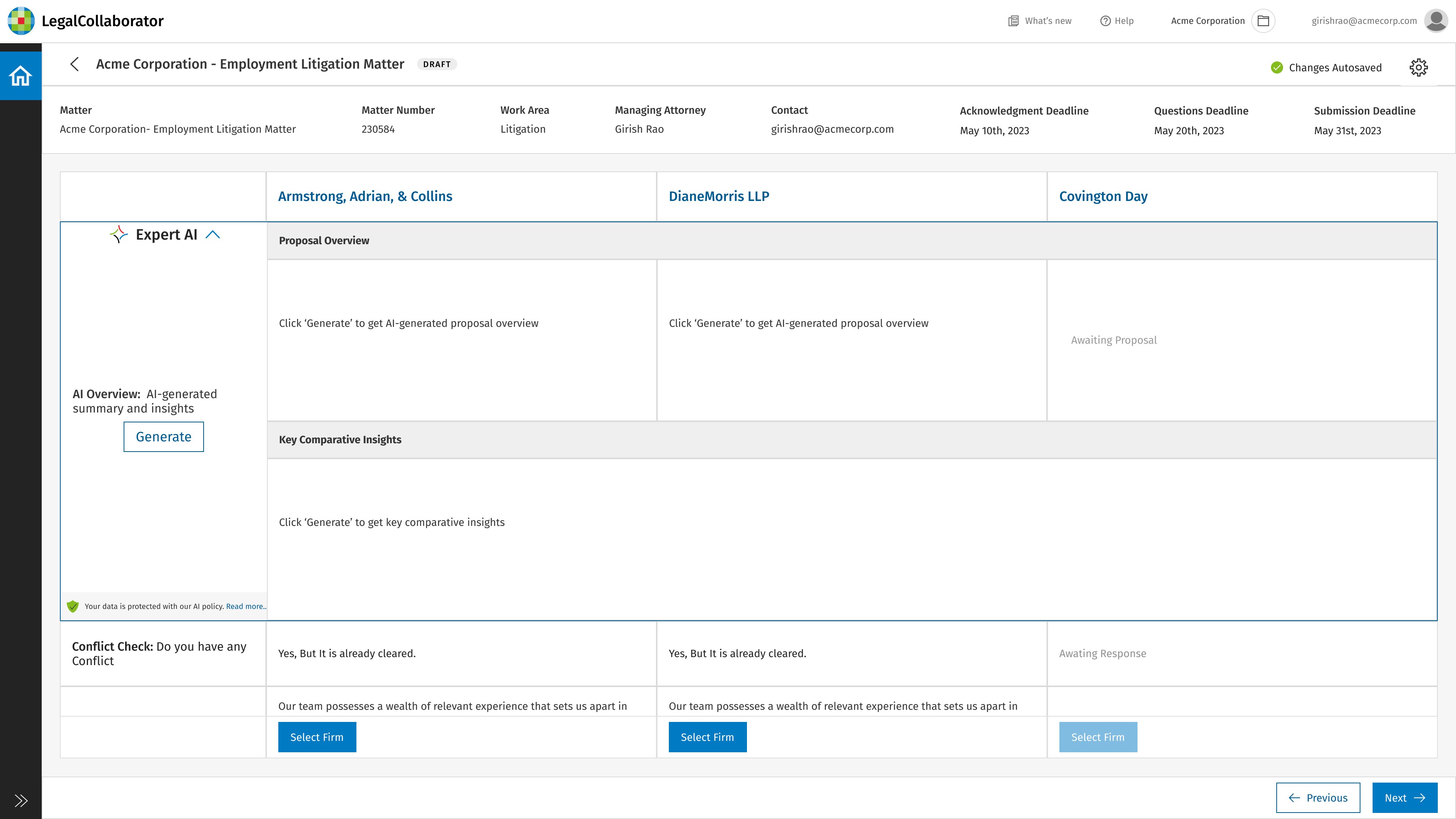
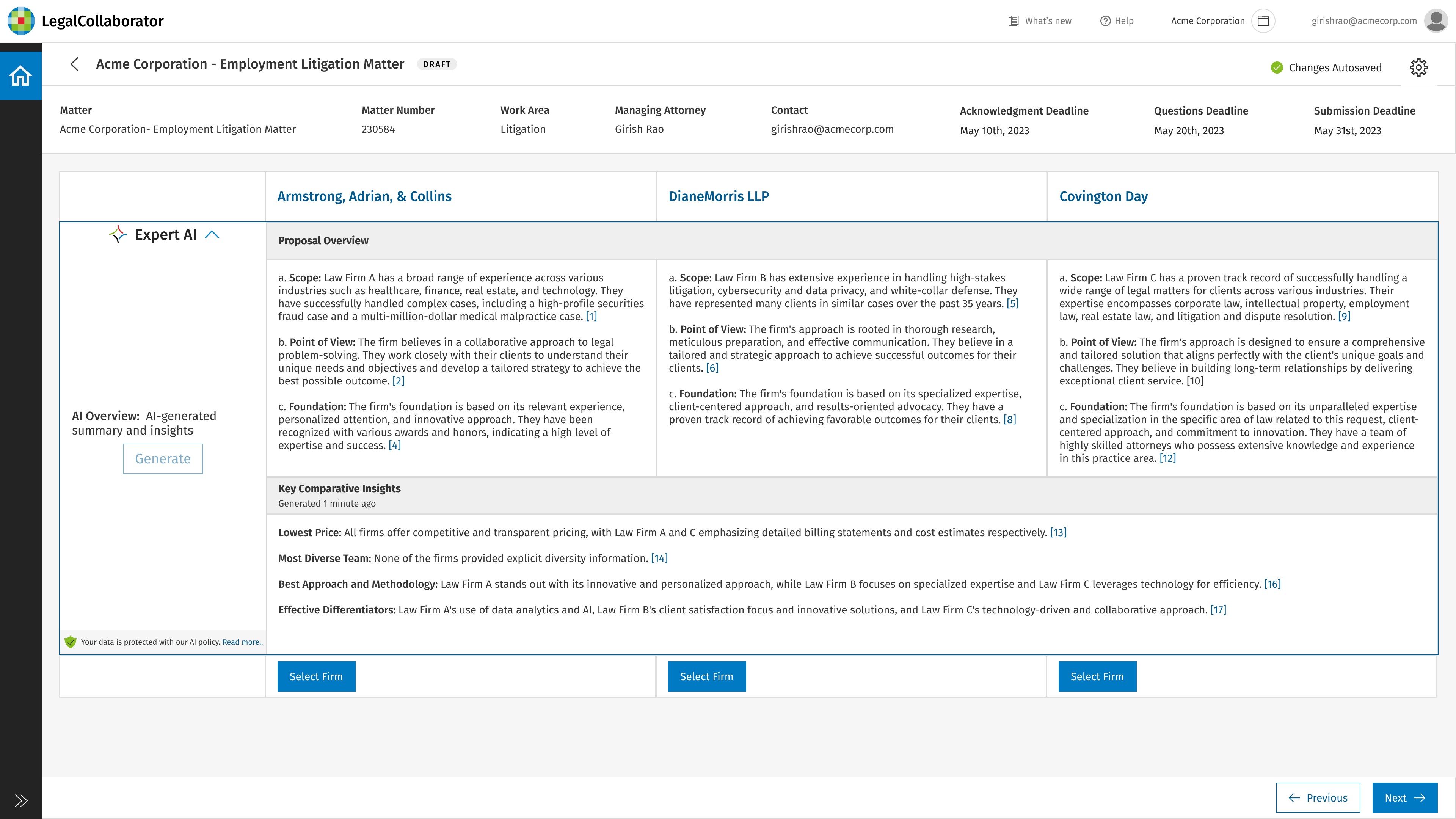
AI-generated summaries with human-in-the-loop review
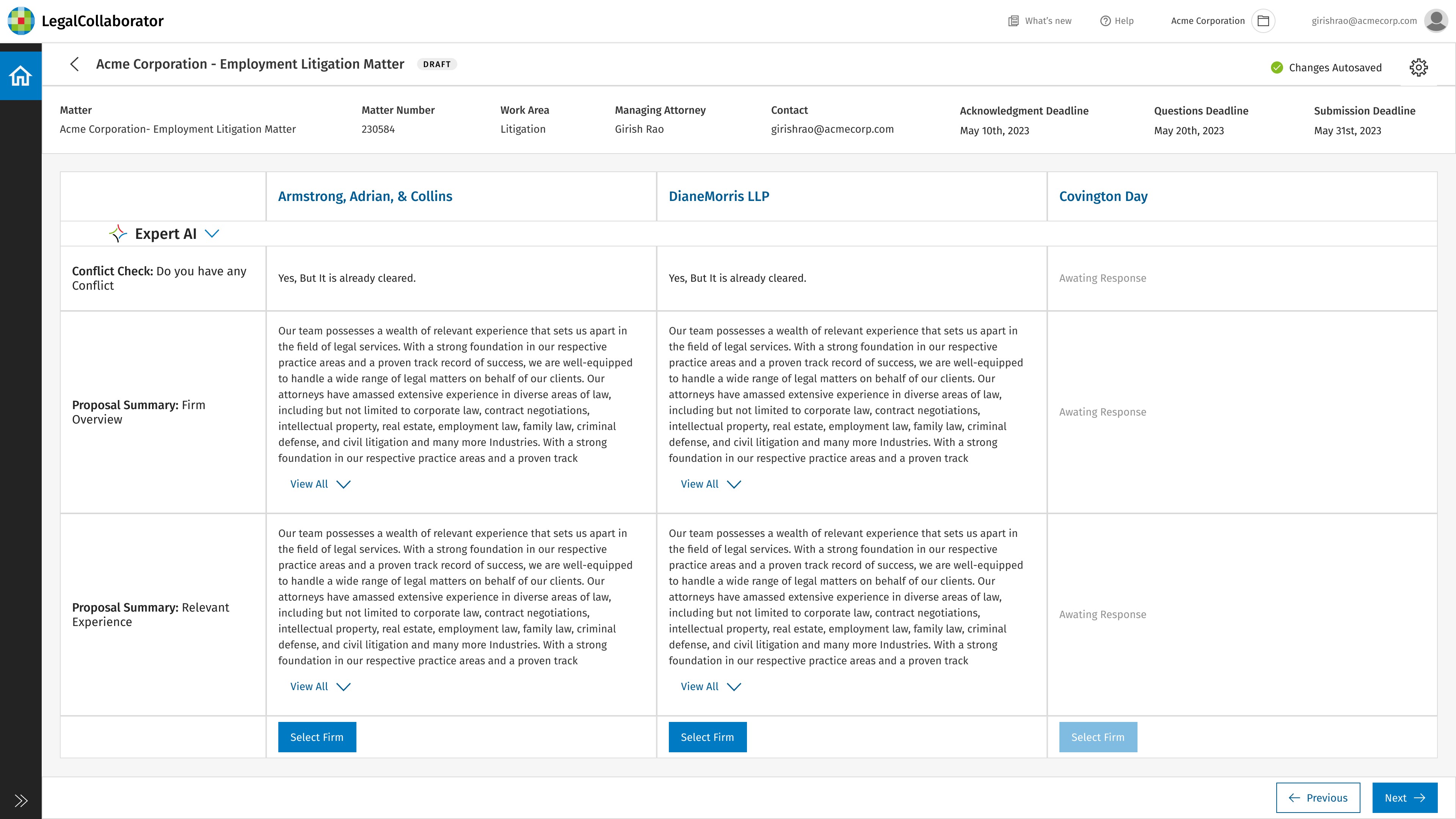
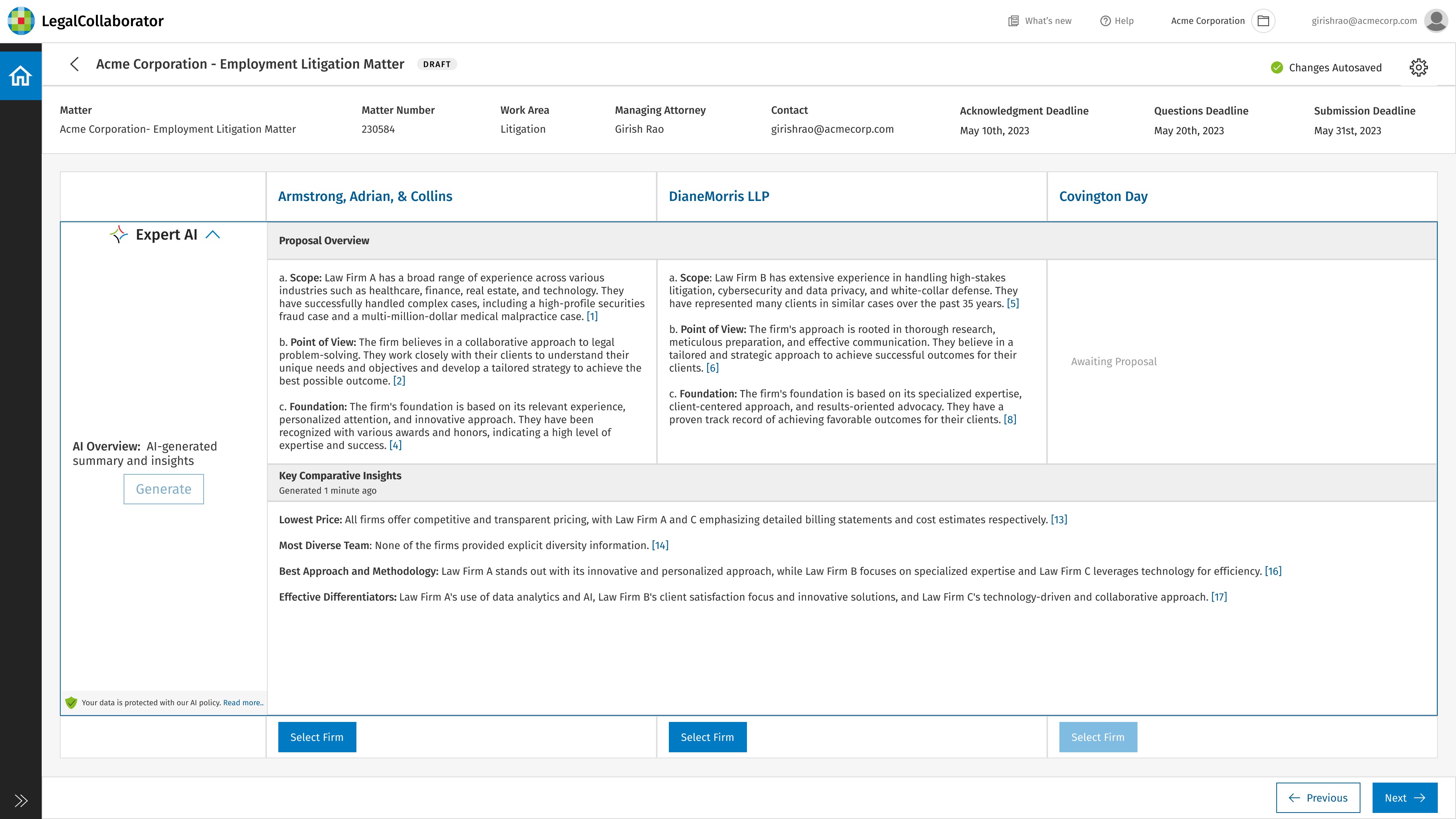
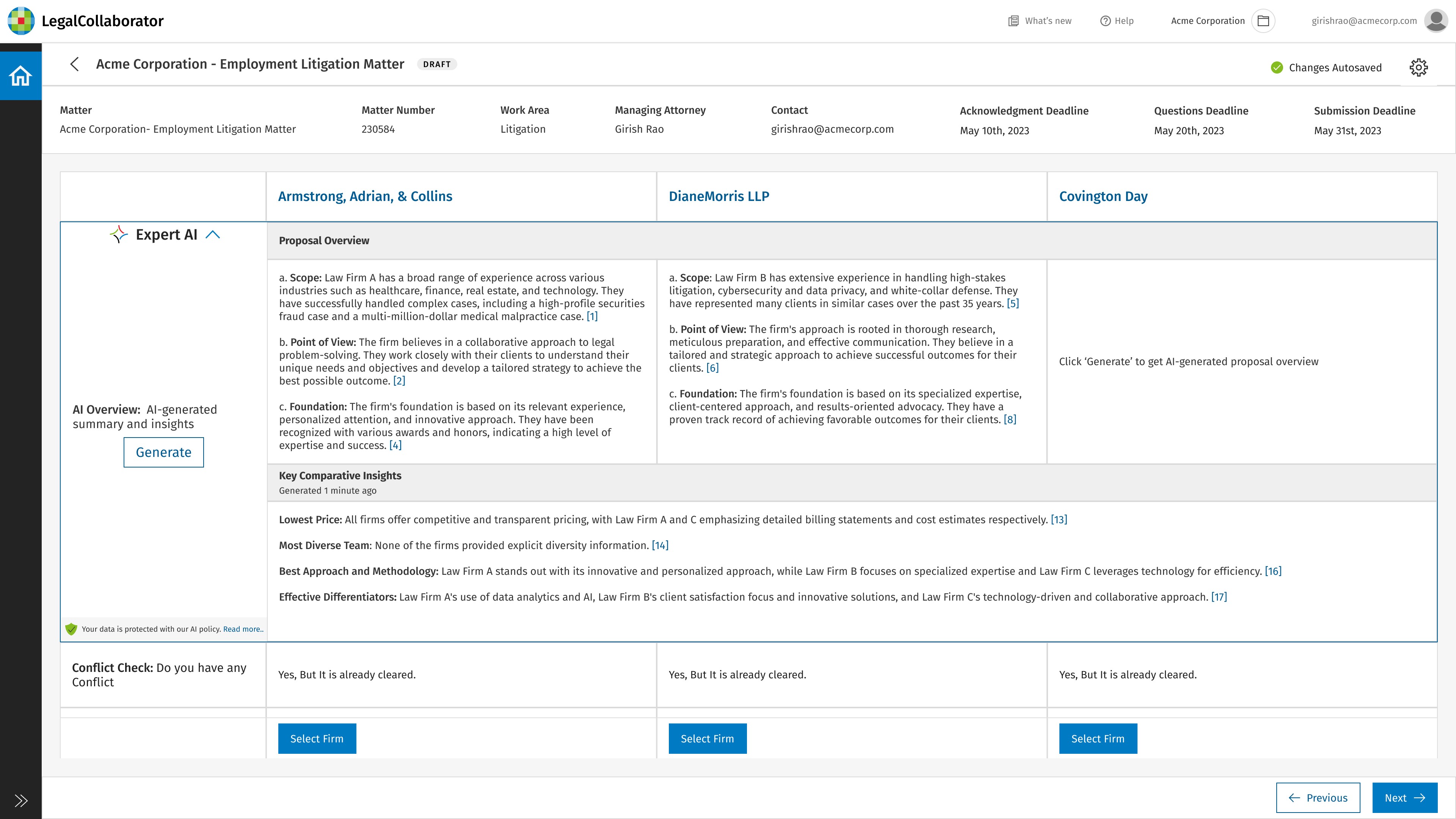
Condensed proposals into comparable summaries (scope, methodology, pricing, differentiators), but built the verify step in as a first-class part of the flow, not an afterthought. The attorney is always the decider.
Comparative scoring against fixed RFP criteria
The same criteria across every firm, so scores were consistent and explainable, not a black box. This is what made evaluations fair, which is itself a legal requirement.
Confidence indicators + traceable sources
Every AI conclusion showed how sure it was and linked back to the proposal text it came from. This is the core trust mechanism. A skeptical attorney could always drill to the source.
Predictive success forecasting
Used historical engagement data to flag likely budget/timeline/outcome performance, framed as a signal to weigh, never a verdict.
Contextual retrieval from past matters
Pulled institutional knowledge (prior matters, billing, benchmarks) into the decision so attorneys didn't have to research it manually.
The Outcome
Up to 40% reduction in manual proposal review time
Attorneys moved from reading lengthy PDFs to comparing structured summaries.
More consistent, defensible evaluations
standardized scoring reduced subjectivity and bias in selection, which matters for compliance as much as speed.
Trust in AI-assisted decisions
The transparency mechanisms (confidence, traceability, human-in-the-loop) are what made the 40% real. Attorneys used it because they could verify it.